At this time of year I’m busy foraging in the woods. The abundance of summer starts to turn over and all sorts of activity is going on. Small animals and birds are collecting provisions to see them through the coming winter, and, in the way that nothing is wasted by nature, old growth, fallen trees and rotting fruit is undergoing varied decaying processes as the weather cools.
Last year’s storms caused havoc here, and many of last years trails are still impassible with fallen trees. Today I rambled along a path and had to climb over, under and around all sorts, trailing through overgrown brambles. Looking up the hill, you could see the awesome level of devastation, trees keeled over in all directions, all stacked against and upon each other like a precarious pack of cards suspended mid-collapse.
Anyway, coming back to foraging: of course it’s a prize to find something, but it’s really made me focus on the environment around me – taking into consideration the weather, tree species (which I am still learning), seasons and ground cover, or the specific substrate where something is growing. You start to understand the certain conditions that nurture what you’re looking for.
So this is a sketch of some fungi – I think maybe ‘dyer’s mazegill’, a fungus that was used by painters to produce ochre hues. I’m not completely sure though, because this is growing like a polypore in a bracket-like formation.
I am still a foraging novice, but one of the most fascinating things about fungi is learning that each species flourishes in specific conditions, sprouting it’s fruiting bodies at the boundaries their domain. A lot of these tend to occur as natural tide marks along the edge of a group of a particular species of trees. You can imagine their vast hidden webs beneath the soil, an invisible power struggle going on beneath our feet.
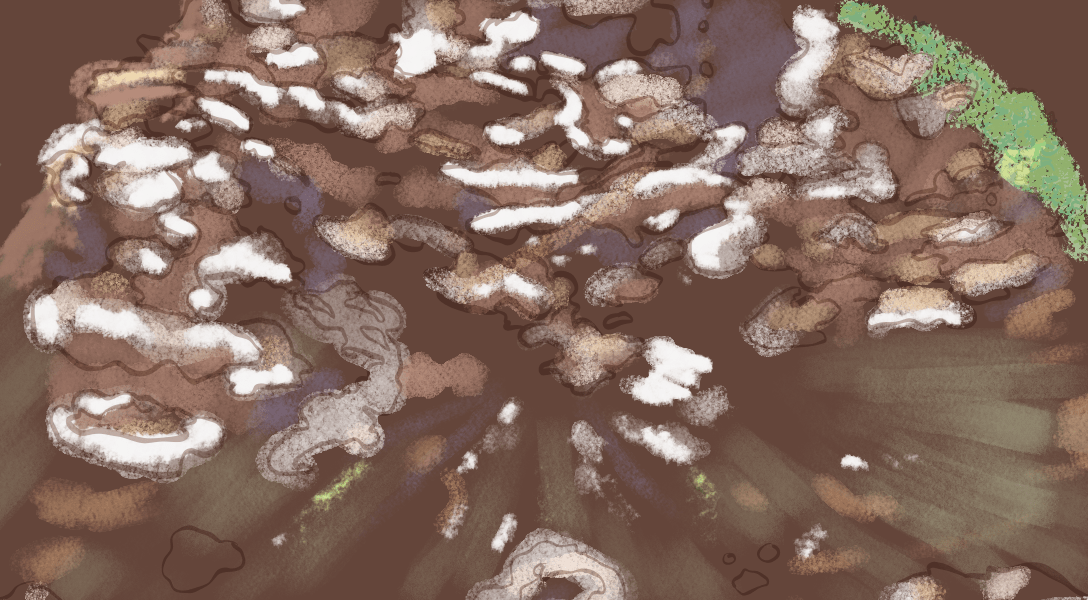
Tidal growth

 meandertect