Slabs

It’s probably worth investing some time in learning Geology. I keep surprising myself with the fact everything we use comes from the ground. It’s easy to forget this, because so much stuff goes through sophisticated processes of refinement and technology before it comes to us as a complete and packaged product.

Geology is fascinating, because it reveals a story, a story through time, of how the earth was formed. Abstracted, imagine each age laid down in these massive time-slabs – sometimes crushing debris and animals in their path, reducing them to mere pages. Sometimes these pages are then bent and buckled or scorched or cooled – how rapidly or slowly dictates the formation of different crystals and deposits. Then there is water, with its huge, awesome force, traversing this activity, ripping through the earth.

I keep thinking I wish I paid more attention to it at school, because I feel I know so little of it now. But I didn’t appreciate any of this at the time, and my geology teacher was not charismatic. It isn’t ever too late to learn, just time is not on my side.

The local coast is dramatic, often rocky, defined by semi-metamorphic rock, in some places jutting out of the sands and mudflats diagonally several metres high. The rocks of the cliff sides churn then slam down into the shore.

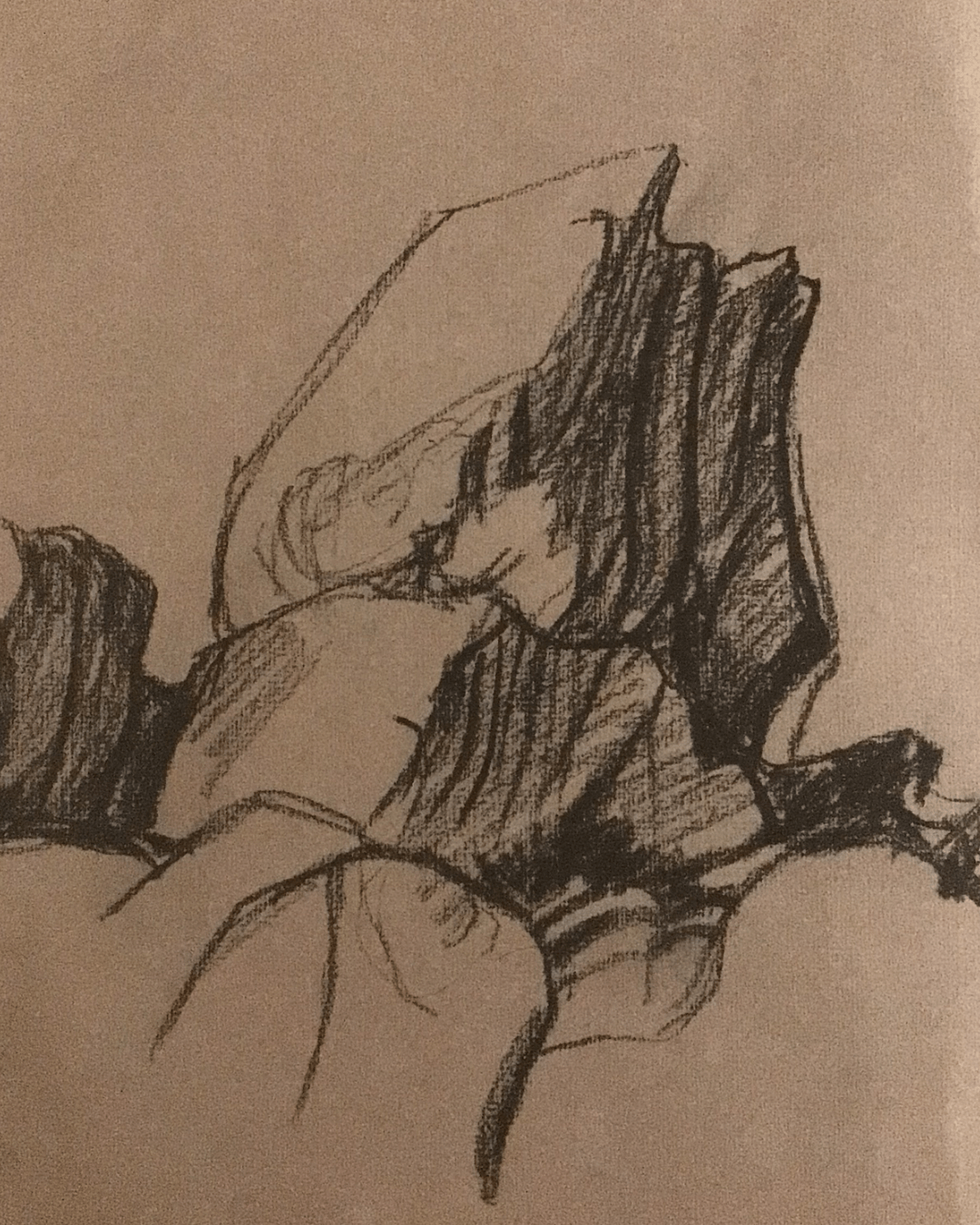
This particular sketch is a solitary upright slab. These sort of slabs are interesting in themselves. It makes me think of gravestones, and how we feel a need to mark a life. These slabs are in effect their own markers of a time and circumstance.
Vectors

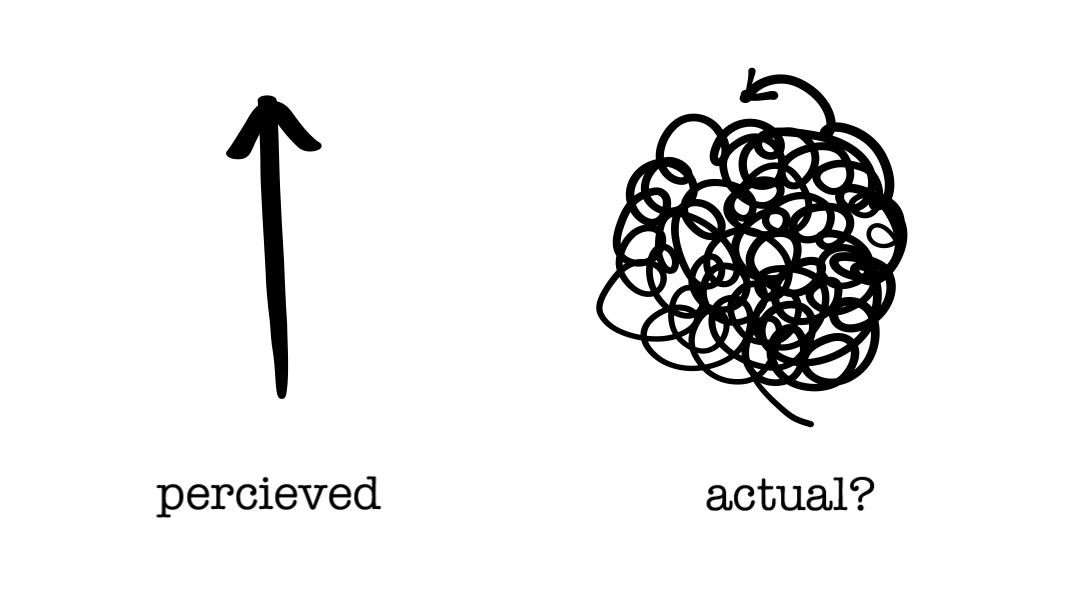
A quantity of both magnitude and direction. I remember first being introduced to the concept; realising that direction is merely a changing position relative to another point. But in our expanding universe, spiralling galaxy, orbiting earth and rotating planet, wouldn’t it be fascinating to trace the actual path of your own body through space, for instance, in your own lifetime? Or the earths, or our sun, through its lifetime? Again – this path, its distance, its speed, could only be presented as a comparison to a ‘fixed’, but, actually also, moving point! Nothing is static, except maybe the centre of the universe…even then some scientists suggest (I’m not sure how far the theory is proved) that there is a multiverse. I would hazard a guess that our own expanding universe is also not static stacked against these other universes.

When Copernicus developed the heliocentric model that Galileo famously later fought to prove through his Dialogue of the Two Chief World Systems, the theory was ridiculed by Galileo’s fictional character, Simplicio, for suggesting that we could be travelling at such a speed without being swept off the face of the Earth. Galileo’s opposing, Copernican-theory supporting character, Salviati, suggested the analogy of a ship – making the first argument for relativity. Of course, day to day, we have to stop thinking in these crazy spiral upon spiral upon spiral terms and just make it from here to there. It’s just not useful. The scale of space and time makes the ‘real’ (spiralling etc) movement irrelevant to us.

Or does it? Considering the more developed, modern theory of relativity, anything travelling faster than the speed of light starts to travel back in time. If you’re looking for a non-scientific explanation of this, read (or try to read, though warning: it may make you lose your mind) Shrodinger’s Cat for an expanded, not-too-sciencey explanation. When we consider that speed is relative, what does this actual mean!!!? We are already (not even theoretically!) moving faster than the speed of light, compared to something else. The light you shine from your torch…are you not moving back in time compared to it when you shine it away from you? How might the light, from its own position, perceive you?

So what am I getting at with this entry? Don’t ask. I don’t even know! Maybe it’s just that, again, vectors, distance, speed….even our own ‘physical’ existence…these are all constructs we have created and simplified for our selves to understand and use within our own context and existence. Who knows what it actually looks like from any other multitude of angles…

Corrections (thanks to my brilliant uncle):

The discussion referred to in Galileo’s Dialogue is the trialogue between three fictional characters arguing the pros and cons of a, strictly hypothetical (!), theoretical heliocentric system vs the Ptolemaic (Geo-centric) system.

Shrodingers Cat – I’m referring to a book I read, far too many years ago, that is actually about quantum physics more generally, presented in layman’s terms: In Search of Shrodinger’s Cat by John Gribbin